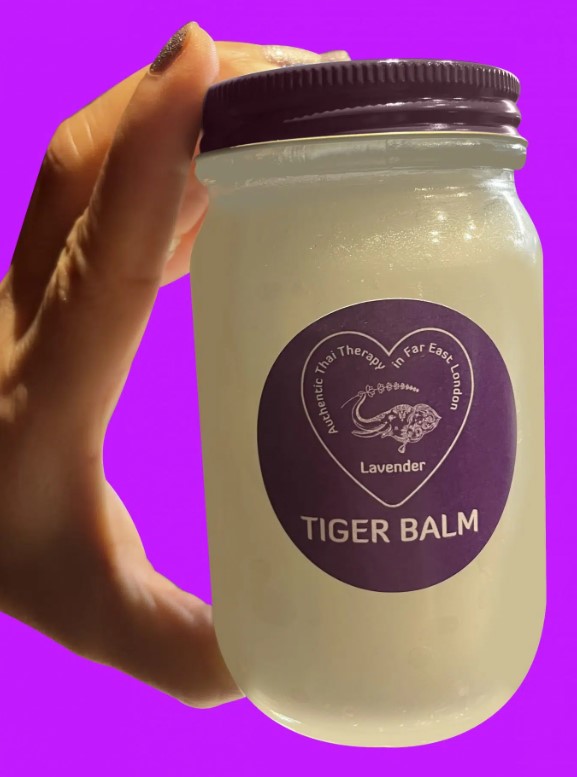
Tiger Balm must be one of the earliest truly global Asian health brands. The product is a successful over-the-counter medicinal ointment, generally used for the fast, temporary relief of muscle aches and pains.
Its main active ingredients are camphor and menthol, blended with cajuput oil, clove oil, and peppermint oil. There are two formulas, red and white. The red formula has a stronger warming effect, often used for deep muscle aches. The white formula produces a milder cooling sensation often preferred for tension headaches, chest congestion, and insect bite itch relief.
Tiger Balm is associated with martial arts training, sports recovery and physical labour relief. It is not however, an ideal primary massage medium. Where used during sports massage. It is applied:
- After the massage as a finishing product
- On specific tight or sore areas (e.g. calves, shoulders, lower back)
- To create a warming or cooling sensation that enhances perceived relief
- As part of pre-event warm-up (light use) or post-event recovery
Some professional sports massage therapists prefer not to use Tiger Balm during the main treatment because:
- It is too intense on the skin, especially after deep tissue work
- It can irritate sensitive clients or recently worked tissue
- The strong smell isn’t always felt appropriate
- It limits glide control compared to oils or waxes
Where Tiger Balm is used as an aftercare product, it is best used sparingly, but with intention.
Tiger Balm’s origins and symbolism
Tiger Balm’s origins can be traced back to the capital of British Burma, Rangoon in the late 19th century. A herbalist, Aw Chu Kin, created the original formula, this was developed by his sons, Aw Boon Haw and Aw Boon Par. The refined formula was turned it into a commercial product in the early 1900s. Business operations were later moved to Singapore, where the product became internationally known.
The brand name “Tiger Balm” symbolised strength, vitality, and healing power—qualities associated with the tiger in Chinese culture. In Asia it has become a became a household “first-aid” essential. It has gained appeal globally as people seek natural or traditional remedies.
Bridging Tiger Balm with Thai massage philosophy
At first instance, Tiger Balm and Thai massage seem different—one is a balm, the other a hands-on therapy. But philosophically, they do closely align.
- In Traditional Chinese Medicine, Tiger Balm works by stimulating circulation and influencing the flow of Qi (energy)
- In Thai massage, the focus is on Sen lines, pathways through which life energy flows.
The crossover – both systems believe pain and tension arise when energy flow is blocked or stagnant—and both aim to restore movement and balance.
Tiger Balm creates a strong hot/cold sensation on the skin. Thai massage uses:
- Pressure and stretching
- Rhythmic compression
The shared principle is “stimulation of the body to awaken its own healing response.” Tiger Balm does this chemically (menthol, camphor). Thai massage does it physically (hands, elbows, body weight).